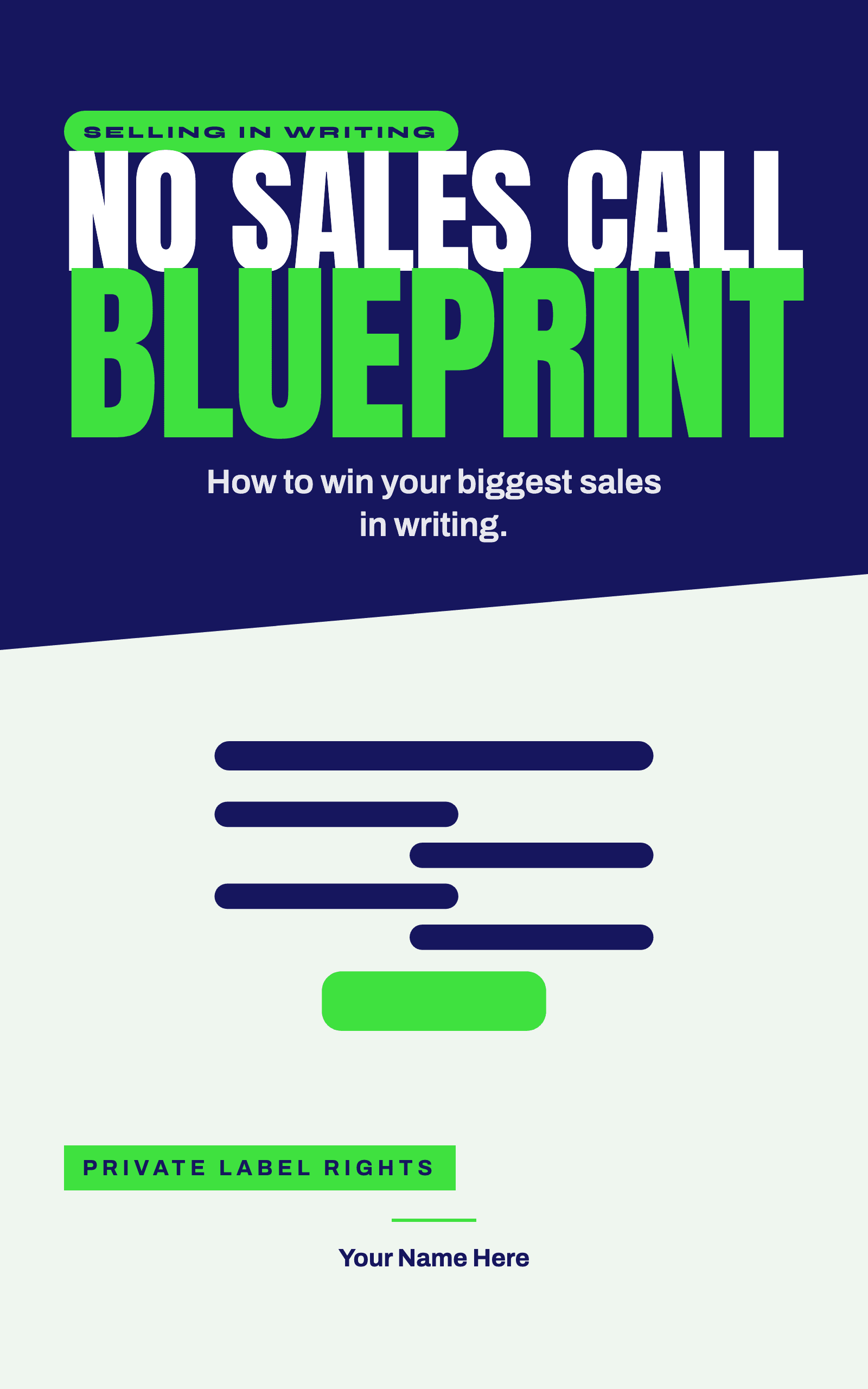
No Sales Call Blueprint: How To Win Your Biggest Sales In Writing
A finished 50 page book for everybody who can sell something expensive perfectly well and cannot face another hour on a call to do it.
Powered by Stripe. All sales final.
You are not just buying this to read it. You are buying the right to sell it.
PLR stands for Private Label Rights. It means you get the finished product plus a licence to put your own name on it, change it however you want, and sell it as your own work. You keep one hundred percent of what you charge. There is no revenue share, no reporting, and no renewal.
What you can do
- Put your name on it as the author
- Change the title, cover, chapters and examples
- Sell it as your own product at any price you set
- Give it away in exchange for an email address
- Bundle it with your other offers
- Translate it, record it as audio, or turn it into a course
- Split it into smaller products
What you cannot do
- Resell the PLR licence itself to other creators
- Claim you wrote the raw source content
- Use it to build a direct competitor to AgentSkillVault
- Combine several PLR licences into one product without written permission
How people use it
- Download the source files the moment payment clears.
- Rebrand it. Your name, your cover, your voice, your examples.
- Package it. Add bonuses, a workbook, or a short video walkthrough.
- Sell it. You set the price and you keep every dollar of it.
The licence is granted to one buyer and covers this product only. It starts the moment your payment clears and it does not expire. See all PLR ebooks.
How It Can Help You
The call was never the part that sold anything. Chapter 4 is the whole argument in one page: the method has three stages, the ask, the written conversation and the letter, and the sale happens in stage two. By the time somebody opens the letter the decision is already made, which is why every attempt at this that fails puts its effort into the document. Take the call out and what is left is a short message, a list of questions and a few pages of writing, none of which has to be finished before the reader starts, because the conversations they have this week are what finish them.
Who's This For
You are good at the thing you sell and the call is the part you dread. It burns an hour, it runs on adrenaline, it costs you the same energy whether the answer is yes or no, and you cannot rewrite what you said afterwards. So you schedule fewer of them, and you sell less. This book is for that person, and it does not tell them to get better at calls. It removes the call from the sale and shows them that the written version is not a weaker substitute, it is the version where they can think.
Look Inside
Real pages from the book you are buying.
Read it before you buy the rights to it.
The contents page and the opening chapters, straight out of the finished book. No notice pages, no filler.
What's Inside
Every piece, broken down.
The finished book, 50 pages
No Sales Call Blueprint. Eighteen chapters in four parts. Why the call was never what sold, getting a hand in the air, the written conversation where it is actually won, and the letter that finishes it instead of a sales page. Designed and ready to sell exactly as it is.
The editable Word file
All 6,826 words as a .docx. It opens in Word, Pages, Google Docs and LibreOffice. Swap the placeholders for your name and it is yours.
The same book as a plain text file
A plain text copy of the whole book, for anyone who would rather work in a text editor or feed it into another tool.
The four lines the first message is made of
Chapter 6, and the third line is the one almost nobody writes. Wherever an audience quietly dreads a standard part of how something is normally done, say plainly that your version does not involve it. A reader who has avoided a whole category because of one thing they hate stops dead on that sentence.
The chapters on restraint, which is the half most material leaves out
Chapter 13 on why answering what is in it loses the sale. Chapter 12 on when an answer is not an answer. Chapter 14 on when to stop asking. Chapter 17 on never inventing a figure. Four of the eighteen chapters are about what not to do.
Three editable covers
Three finished covers at 1600 by 2560. You also get the HTML file behind each one, with the text and the colours marked so you can change them. How to export is included.
The sales kit
A sales page. Five launch emails. Ten social posts. Three ad angles. A note on where to sell it. And written compliance notes: no income claims, no figures you cannot evidence, and a real refund line if you publish one. Run them as they are.
The quick start
One page. Download to a live listing in about an hour, in the right order. It also names the short pages that have to stay in the book when you put your name on it, and why.
Your PLR licence, made out to you
A certificate with your name, a licence number and the date on it. It says exactly what you can do with the book. It comes as its own download at checkout.
How To Use It
One file, 6 ways to sell it.
Sell it exactly as it is
Finished, designed, gated and ready. List it today, set your own price, keep every dollar.
Put your name on it first
Three placeholders in the Word file, one of the three covers, and a short paragraph at the end about who you are. Twenty minutes.
Sell it the way the book says to sell
This is the only book on the shelf whose method you can run on the book itself. Post the four line message, have the written conversation, send the letter. Your buyer watches it work on them before they read it, which is a sales argument nothing else here gives you.
Build the question sheet as a printable
Chapter 10 gives three things the reader has to find out and Chapter 11 gives the way to ask for them. One page, three headings, a bank of questions underneath, space to write, sized for one side of paper. It is the one thing in the book somebody uses the same afternoon, and a worksheet is what people photograph and send on.
Sell it to anyone who sells by talking
Coaches, consultants, agencies, studios and anybody running a service where the standard route is a booked call. They all know the call is the bottleneck and none of them has a finished alternative to hand over.
Bundle it with anything you sell about getting attention
Audience products stop at the follower. This one starts at the person who put their hand up, so the two do not compete, they finish each other.
What You Can Sell It For
Suggested resale price: $37 to $47.
You pay $14.99 once. You set your own price after that, and you keep every dollar of it. Here is the simple math on 50 copies.
Priced at $37, 50 copies sold
$1,850
potential
Priced at $47, 50 copies sold
$2,350
potential
That is arithmetic on a price you choose, not a promise. We have no way of knowing what you will sell, and nobody honest would tell you otherwise. What you make depends on your price, your audience and your work.
The Transformation
Before vs after.
Before
- An audience that sells well in person and quietly schedules fewer calls every month
- Material that teaches call scripts, which is the opposite of what this reader wants
- Nothing in your shop for somebody whose bottleneck is their own calendar
After
- A whole package rebranded and listed in an afternoon
- Three stages, and a clear statement of which one actually closes the sale
- No prices, figures or platforms printed anywhere, so nothing in it becomes your claim
This is for you if…
- Anyone selling to coaches, consultants, agencies or service businesses where the standard route to a sale is a booked call
- Course sellers who need a finished product for an audience that already has an offer and hates selling it
- Anyone whose audience is introverted, time poor, or selling across time zones where a call is genuinely expensive to arrange
This is NOT for you if…
- You want cold outreach. Everything here is written for people who already know who the reader is, and Chapter 3 is honest about what happens when they do not
- You want scripts to paste. The chapters that look like they should hold one deliberately hold a shape instead
- You want to give it away free, which the licence does not allow
FAQ
The questions everyone asks.
Does it name any software?
No app, platform or piece of software is named anywhere in it, on purpose, and that was measured rather than assumed. The book says why: every one of them will have changed its name, its price or its features before the book is a year old, and none of them is what makes the method work. It holds up whatever the reader is already using.
Is this cold outreach or cold email?
No, and the book says so on its own front page. Everything in it is written for people who already know who the reader is. Chapter 3 is unusually honest about it: if nobody knows you yet, the method is not the problem to solve first, and the chapter says what is.
Does it print prices, conversion rates or income figures?
None anywhere. Chapter 17 goes further and tells the reader never to invent a figure, not an average result, not a typical one. The sales kit asks you to hold the same line, because selling to people who sell things is the most scrutinised category there is.
It mentions payment plans. Is that a problem?
Chapter 17 says plainly that instalment selling is regulated in some places and sends the reader to find out what applies where they are. It does not tell anybody how to set one up. If you edit that chapter, keep the sentence, and keep the disclaimer page at the front for the same reason.
What exactly am I allowed to do with it?
Put your name on it. Change the title and the cover. Rewrite any part of it. Translate it. Turn it into a course or an audiobook. Bundle it. Sell it at any price, anywhere, and keep every dollar. The full licence comes with it.
What am I not allowed to do?
You cannot give it away for nothing, though an email address in exchange is fine. You cannot put it in a free membership site. And you cannot pass the resale rights on to your own buyers.
How is it delivered?
One zip file with sixteen items in it, right after checkout. Your licence comes as a second download with your name on it.
Will other people be selling the same book?
Yes. That is how these rights work at this price. It is also why you get the editable files. The title, the cover, the examples and the voice are all yours to change.
Stop reading. Start shipping.
$14.99, one time, lifetime access. The cost of waiting is bigger than the cost of buying.
Other books you can rebrand and sell
Home Remedies: A Step By Step Guide To Making Tea, Syrup, Oil and Poultice
A finished 48 page book that teaches the ten skills behind almost every home remedy there is, step by step. Not a list of recipes. The actual how to. You get full rights to put your name on it and sell it. The designed PDF. The editable Word file. A plain text copy. Three covers you can change. A full sales kit. And a one page quick start. Seventeen chapters in four parts. Ten methods are taught, so a reader can put almost any suitable plant through them: tea, root and bark brews, tinctures, syrups, infused oils, salves, ointments, poultices, which are warm pastes laid on the skin, herb vinegars and conserves. Around them sit seven chapters on the craft that decides whether any of it works. When to pick. Drying without losing the strength. Straining and pressing. Jars, bottles and labels. What each liquid pulls out of a plant. The water you use. And how to tell when something has gone bad. It promises nothing about anybody's health.
What To Say: Fill In The Blank Scripts For Posts, Messages, Sales Calls and Emails
A finished 91 page book of word for word scripts with the blanks marked, for the four places a business owner has to say something: posts, messages, the sales call and the emails. You get full rights to put your name on it and sell it. The designed PDF. The editable Word file. A plain text copy. Three covers you can change. A full sales kit. And a one page quick start. Four parts and thirty sections, with more than three hundred marked blanks, so the buyer's reader fills in their own business instead of sending somebody else's words. Part One is posts: how to decide what to post about, the story post taken apart line by line, three ways to announce something without hype, and the full offer post annotated so the reader can see the job every line is doing. Part Two is messages: how to tell a useful room from a dead one, the connection request, the first message explained line by line, a complete ten turn conversation written out, and two ways to ask for the call. Part Three is the sales call: the shape of it with times against each part, the three questions that do most of the work, the seven steps of making the offer including the price and the silence after it, and the four things people say when they are hesitating, each answered with a question. Part Four is the emails: three complete sequences written out email by email, the six after somebody joins a list, the three before something live, and the seven after somebody buys. No app names, no menus and no settings anywhere in it, so it is still correct in two years.
The One Look Blueprint: How To Make Everything Your Business Puts Out Look And Sound The Same
A finished 47 page book on making a small business look and sound like one company, with full rights to put your name on it and sell it. You get the designed PDF. The editable Word file. A plain text copy. Three covers you can change. A full sales kit. And a one page quick start. Seventeen chapters in four parts. Part One is why it all looks different: a ten minute test that shows the reader the problem with no software, why trying harder makes it worse, what being recognised actually buys them, and the six things to settle and the order to settle them in. Part Two is how it looks: the one job a mark has to do, the single colour people will end up naming the business by, the three colours that support it, judging two fonts in five minutes without knowing anything about type, the one change to the space on a page that makes homemade work look bought, and the three things every photo has to share. Part Three is how it sounds: the voice the reader already uses when nobody is watching, three words for how they talk and three for how they do not, the words they always use and the ones they never use, and what it costs when the thing they sell has two names. Part Four is making it stick: writing the one page sheet, handing it to somebody else without a meeting, and the three fair reasons to break your own rules. It names no font, no colour tool and no app anywhere in it, on purpose, so it is still correct in five years.
The AI Rollout Blueprint: How To Get Your Team To Actually Use It
A finished 49 page book on getting a team to actually use the system the business already paid for, with full rights to put your name on it and sell it. You get the designed PDF. The editable Word file. A plain text copy. Three covers you can change. A full sales kit. And a one page quick start. Eighteen chapters in four parts. Part One is why good systems get ignored: that the tool is almost never the problem, why change feels like losing something even when it is an improvement, why the objection people say out loud is not the one they actually have, and what happens when you automate a job that was already broken. Part Two is the people in the room: the five people who decide whether this lives, why the enthusiast is the risk nobody plans for, why the loudest objector is usually right about something, and how to find the quiet one everybody copies. Part Three is building it so they want it: anchoring it to something that already hurts, building it with the team rather than for them, telling them before the launch instead of after, engineering the first win on purpose, and keeping it boring and simple. Part Four is landing it and keeping it: training the habit rather than the buttons, showing the result loudly and early, four kinds of resistance and what each one needs, why silence is where these projects die, and why the handoff is an emotional moment rather than a technical one. It names no application, model, vendor or company anywhere in it, and it prints no costs, percentages, timelines or headcounts at all, so it stays correct whichever system the reader bought and however long it sits on your shelf.
Want to see everything in the vault?
Browse all 81 digital products